

Psychedelic treatment reveals addiction-like behavior in anorexia animal model, not expected social withdrawal

Psilocybin mushrooms (Psilocybe cubensis). Researchers found that the psychoactive compound psilocybin produces opposite inflammatory and behavioral effects in female mice depending on exercise history and metabolic state. Credit: DepositPhotos.
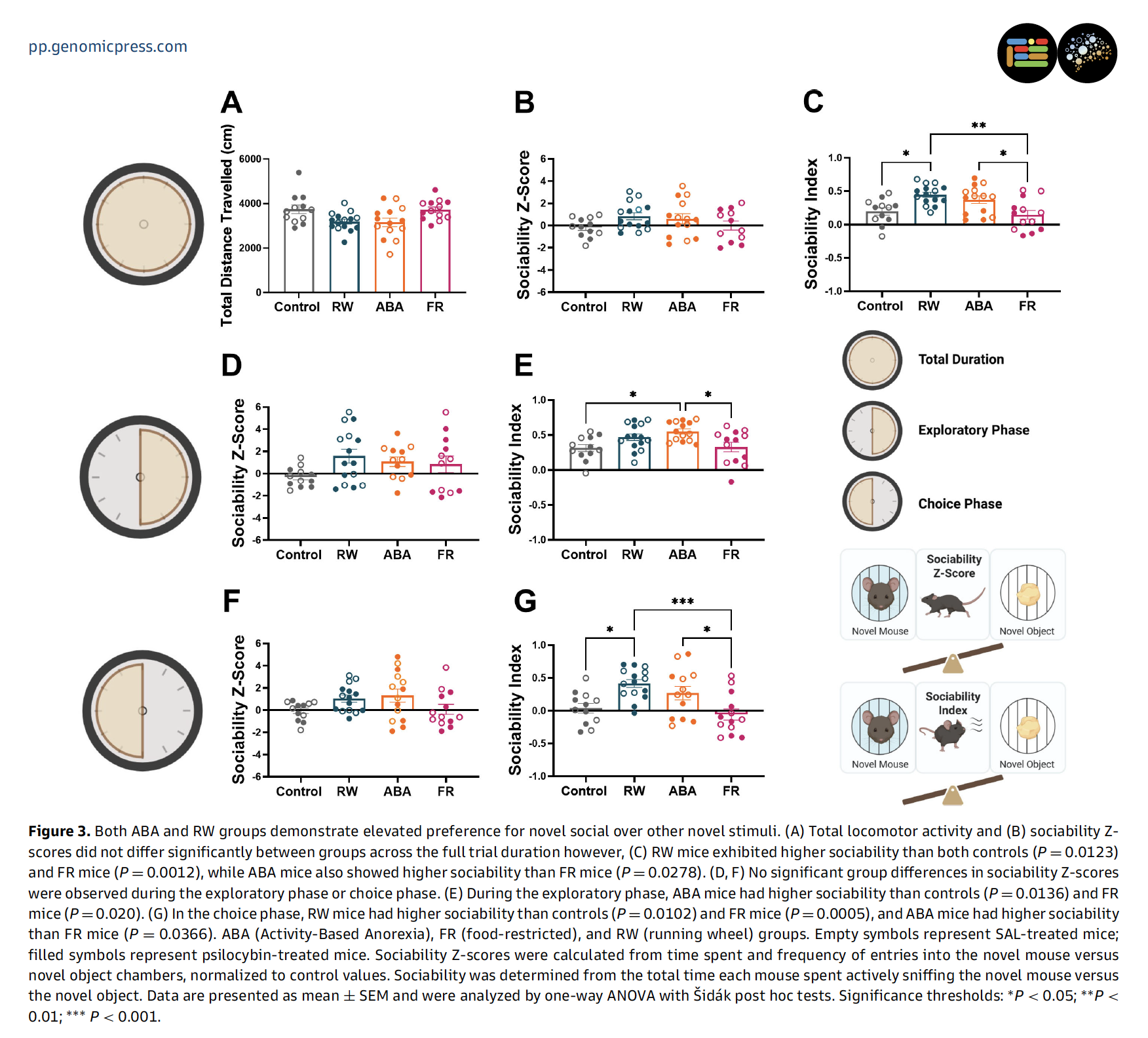
Both activity-based anorexia (ABA) and running wheels (RW) groups demonstrate elevated preference for novel social over other novel stimuli. Empty symbols represent saline-treated mice (controls); filled symbols represent psilocybin-treated mice.
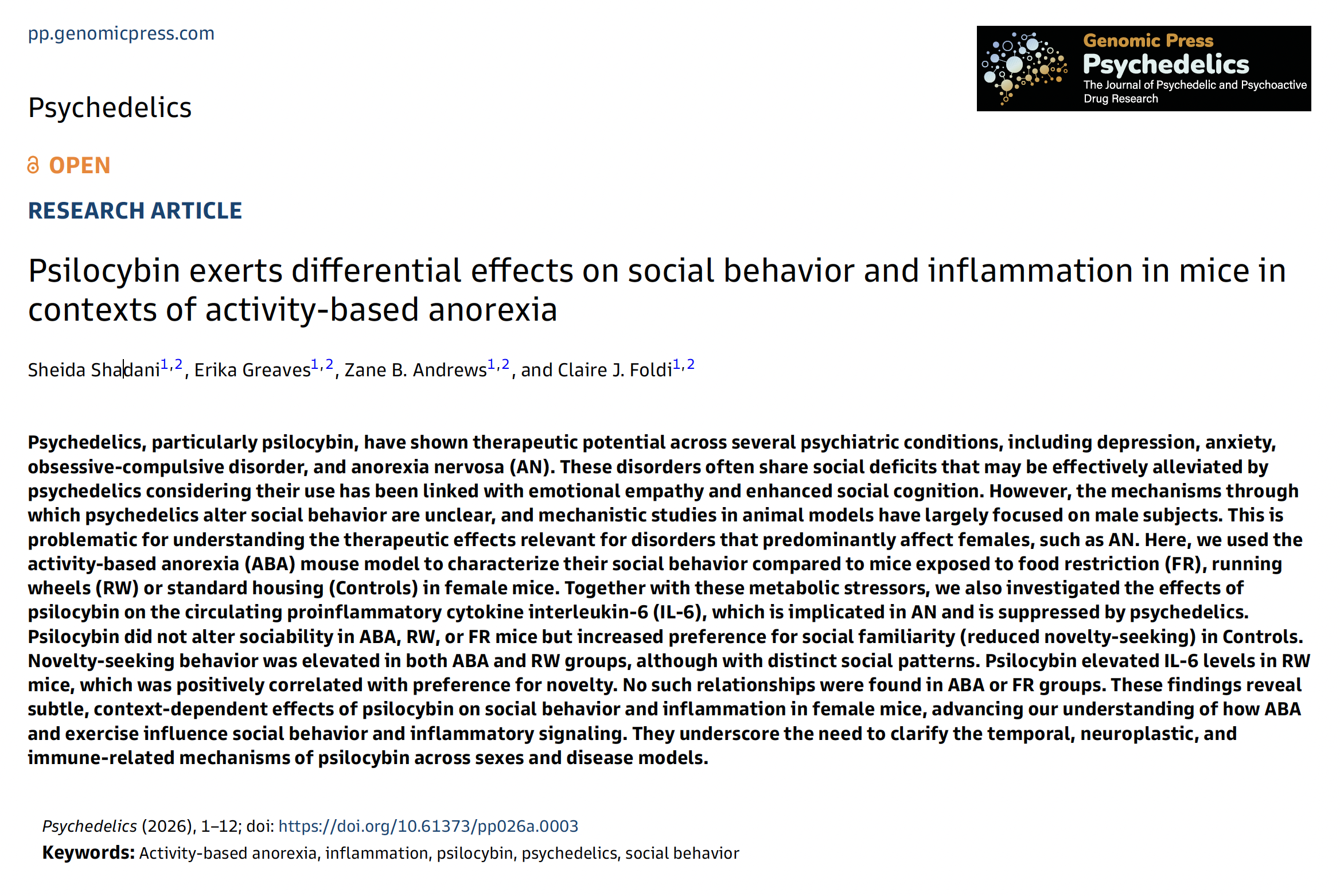
Psilocybin exerts differential effects on social behavior and inflammation in mice in contexts of activity-based anorexia.
Anorexia-model mice showed addiction-like novelty-seeking, not withdrawal. Psilocybin raised IL-6 only in exercising mice, linking inflammation to sociability.
The discovery emerged from experiments designed to test whether psilocybin could rescue social deficits in an anorexia model. Instead, Associate Professor Claire Foldi and doctoral researcher Sheida Shadani observed something unexpected: anorexia-model mice showed significantly greater interest in novel social partners than any other group, including controls, food-restricted mice, and exercising mice. This heightened novelty-seeking persisted across all phases of behavioral testing.
Prior research has demonstrated that heightened novelty-seeking in rodents predicts vulnerability to transition from controlled to compulsive cocaine use, even in the absence of baseline hyperactivity. Individuals with anorexia nervosa show elevated rates of substance use disorders and often exhibit emotional dysregulation alongside compulsive exercise patterns. The behavioral profile observed in anorexia-model mice may therefore reflect shared neurobiological features between eating disorders and addiction, a "compulsive phenotype" that manifests as maladaptive reward-seeking regardless of the specific target, whether drugs, food restriction, or excessive exercise.
"We may need to reconceptualize what the anorexia model is showing us," explains Foldi. "Rather than social avoidance, these mice display goal-directed exploratory motivation. The heightened novelty-seeking could represent a compensatory response to restricted reward, or it could reflect the same compulsive tendencies that drive both eating disorders and substance use disorders in patients."
The study's second major finding emerged from immune measurements taken seven hours after psilocybin administration. Mice with running wheel access showed interleukin-6 (IL-6) levels nearly triple those of saline-treated controls after receiving psilocybin. Food-restricted mice and anorexia-model mice showed no such elevation. Human studies have reported that psilocybin reduces IL-6 seven days after administration, correlating with sustained mood improvements, yet here the acute effect was inflammatory elevation, and only in exercising mice.
The behavioral correlation proved equally surprising. Among psilocybin-treated exercising mice, higher IL-6 levels predicted greater preference for novel social partners over familiar ones. A similar pattern emerged in control mice. No such relationship appeared in food-restricted groups, suggesting that prior caloric restriction disrupts whatever mechanism links the compound, inflammation, and social engagement. The finding challenges the conventional view that inflammation uniformly impairs social function.
"The acute timeframe may have captured a transient immune activation that precedes delayed anti-inflammatory effects," Shadani notes. "Voluntary exercise activates dopamine reward pathways and creates a unique metabolic environment. Psilocybin may interact with this context in ways that don't occur under food restriction. Understanding these temporal and physiological dynamics is crucial for predicting treatment response."
Four clinical trials investigating psilocybin for anorexia nervosa have been completed, with two currently recruiting, yet only 40% of participants in early studies showed significant symptom reduction. The present findings suggest that exercise history, inflammatory profiles, and degree of malnutrition may all contribute to this variability. Patients who exercise compulsively, a common feature of anorexia, might show different immune and behavioral responses than those who do not. The correlation between body weight and interest in novel objects over social partners in food-restricted mice hints that nutritional state could shift motivational priorities in ways that affect therapeutic outcomes.
"Personalized approaches may prove essential," Foldi observes. "Our data suggest that a one-size-fits-all dosing strategy may fail to account for the physiological diversity among patients. Exercise status and metabolic state could serve as biomarkers for predicting who responds to psychedelic-assisted therapy."
The absence of social impairment in anorexia-model mice may reflect the acute nature of the experimental protocol. Mice experienced approximately 20% body weight loss over three to four days—rapid but brief. The social difficulties observed in human patients may require longer exposure periods or result from psychosocial factors that preclinical paradigms cannot capture. Emotional empathy deficits in patients worsen during the acute weight-losing phase but may reflect accumulated experiences of loneliness and social withdrawal over months or years of illness.
Recent work in adolescent mice offers an alternative interpretation: hunger-sensing neurons that regulate appetite in adults are also activated by social isolation during adolescence. The enhanced novelty-seeking observed here may represent a homeostatic drive that redirects motivation toward novel social stimuli as an alternative source of reinforcement when food reward is restricted.
Three concrete next steps emerge from this research. Extended anorexia exposure with multiple restriction and refeeding cycles would better model the chronic, relapsing nature of the human condition. Time-course studies measuring IL-6 at multiple intervals after psilocybin administration would clarify when anti-inflammatory effects emerge. Additional inflammatory markers examined alongside brain region-specific neuroplasticity markers would comprehensively link immune modulation to behavioral effects.
The researchers emphasize that male and female subjects likely differ not only in psychedelic metabolism but also in how neural circuits respond to serotonergic modulation. Future research must examine effects across both sexes and at multiple timepoints to identify sex-specific trajectories of change, particularly important for conditions like anorexia that disproportionately affect females.
Sheida Shadani designed and conducted all experiments as part of her doctoral research at Monash Biomedicine Discovery Institute. Erika Greaves assisted with experimental procedures. Professor Zane B. Andrews contributed to experimental design and analysis. Associate Professor Foldi conceptualized the study and oversaw the entire investigation. The work was supported by a National Health and Medical Research Council Ideas Grant.
This peer-reviewed research represents a significant advance in psychedelic science, offering new insights into context-dependent mechanisms through rigorous experimental investigation. The findings challenge assumptions about consistent drug effects and open new avenues for understanding how metabolic state shapes therapeutic response. By employing a carefully controlled comparative approach, the research team has generated data that advances fundamental knowledge while suggesting that personalized approaches may prove essential for eating disorder treatment. The comprehensive nature of this investigation, spanning multiple experimental conditions and examining both behavioral and immune outcomes, provides important insights that will reshape how researchers approach psychedelic mechanisms in metabolically compromised populations. Furthermore, the focus on female subjects demonstrates the power of sex-appropriate model selection to tackle clinically relevant questions.
The Research Article in Psychedelics titled "Psilocybin exerts differential effects on social behavior and inflammation in mice in contexts of activity-based anorexia," is freely available via Open Access, starting on 3 February 2026 in Psychedelics at the following hyperlink: https://doi.org/10.61373/pp026a.0003
About Psychedelics: Psychedelics: The Journal of Psychedelic and Psychoactive Drug Research (ISSN: 2997-2671, online and 2997-268X, print) is a peer reviewed medical research journal published by Genomic Press, New York. Psychedelics is dedicated to advancing knowledge across the full spectrum of consciousness altering substances, from classical psychedelics to stimulants, cannabinoids, entactogens, dissociatives, plant derived compounds, and novel compounds including drug discovery approaches. Our multidisciplinary approach encompasses molecular mechanisms, therapeutic applications, neuroscientific discoveries, and sociocultural analyses. We welcome diverse methodologies and perspectives from fundamental pharmacology and clinical studies to psychological investigations and societal-historical contexts that enhance our understanding of how these substances interact with human biology, psychology, and society.
Visit the Genomic Press Virtual Library: https://issues.genomicpress.com/bookcase/gtvov/
Our full website is at: https://genomicpress.com/
Ma-Li Wong
Genomic Press
mali.wong@genomicpress.com
Visit us on social media:
X
LinkedIn
Bluesky
Instagram
Facebook
Legal Disclaimer:
EIN Presswire provides this news content "as is" without warranty of any kind. We do not accept any responsibility or liability for the accuracy, content, images, videos, licenses, completeness, legality, or reliability of the information contained in this article. If you have any complaints or copyright issues related to this article, kindly contact the author above.
